
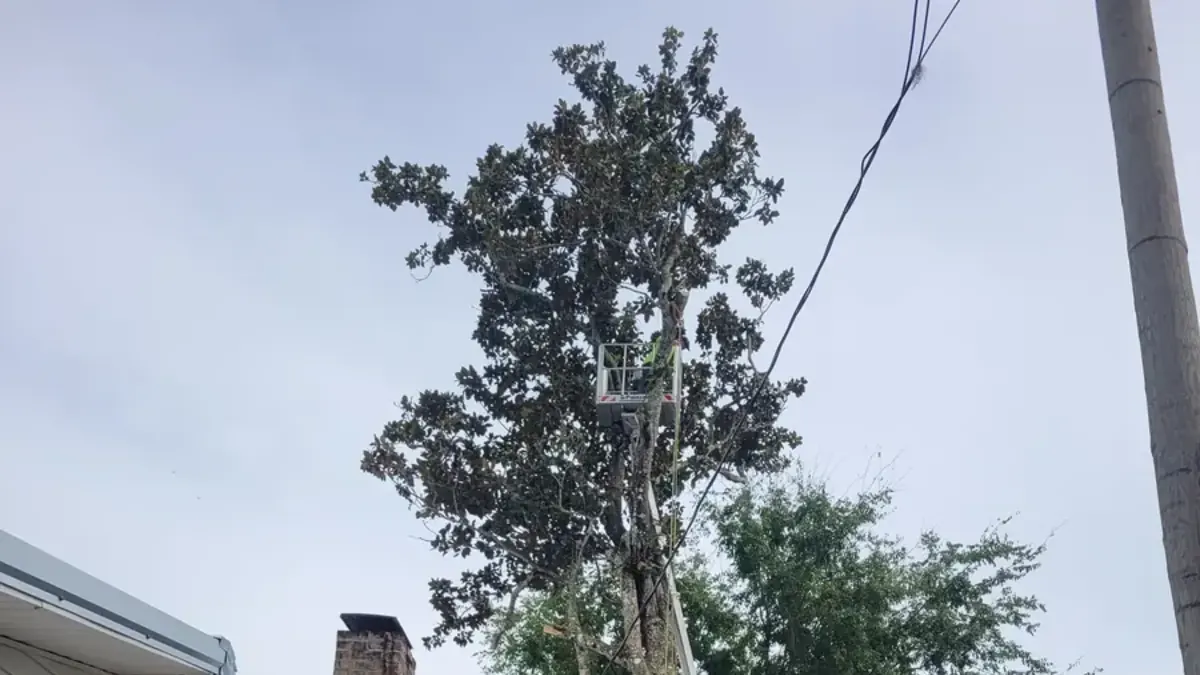
How to Get Your Trees Ready for Hurricane Season in Venice, FL
The tree that wrecks a house in a hurricane usually showed warning signs in July.
· Tree Trimming
You came home and the shade tree is a coat rack. Every limb cut at the same height, stubs where the canopy used to be, sawdust in the grass and the crew already gone. The guy said it would come back thicker. You paid him. Now you're wondering if you just paid somebody to kill a forty year old tree.
The tree can sometimes be saved, if it is the right species and you handle the next few years correctly. But start with what actually happened to it, because that changes what you do next.
Topping means cutting a main stem back to a stub at whatever height somebody picked, with no regard for where the next branch is. Hat-racking is the same move applied to the whole canopy: everything shortened to a uniform outline, stubs sticking out. Both do four things at once.
One more thing nobody mentions. Bark that spent decades in shade is now in full sun. It sunburns and dies in patches on the upper sides of limbs and the trunk, opening more doors for the same decay.
Six months later the tree looks green and busy and you conclude everybody overreacted. That's the most misleading moment in the process.
The tree looks its best right when it's structurally at its worst. Those shoots grow out of the top of wood that started rotting at the cut face the day it was made. In five or ten years you have long, heavy limbs with shallow attachments sitting on a column of decay. That's why a topped tree is more likely to drop wood later, not less. Anybody who told you topping makes a tree safer in a storm had it backwards. Same thinking as the hurricane cut on palms, wrong for the same reasons.
The instinct is to call somebody to fix it right now. Don't. Cutting again takes more of the little foliage it has left and makes the energy problem worse.
Give it a full growing season. The shoots have to exist before anybody can choose among them, and the tree needs reserves back before it can pay for another wound. Water it through the dry season. Skip the fertilizer program somebody will try to sell you. The problem isn't a nutrient shortage, it's a spending problem.
The one exception is hazard. A hanging piece, a split stub, dead wood over the driveway. That comes out now, and it costs the tree nothing.
Restoration is a plan, not a haircut. The goal is a smaller number of well-placed shoots that become the tree's new branches, so structure rebuilds around leaders that are properly attached instead of a crowd fighting for space.
The method is simple and slow. At each visit, look at the crowd of shoots on each stub and pick the one or two best positioned and best anchored. Remove some of the rest, shorten others, leave a portion standing. You don't clear a stub to a single shoot in one go, because that foliage is still feeding a tree that can't spare it. Then come back and do it again.
Over several cycles the chosen shoots take over, thicken, and start building real unions at their base. Dead or rotting stubs get cut back to a live lateral when there's one to cut to. A good restoration visit is light enough that from the street it looks like almost nothing happened.
First restoration visit: after a full growing season, one year out. After that, a visit every year or two for several years. Plan on five years or more before it reads as a tree again from the street. It will never have its original branch structure. It gets a serviceable one.
The decay from the original cuts doesn't reverse. Restoration manages the tree around it. Some of these end in removal ten years later anyway, on a schedule you picked rather than in a storm. Still a win over the alternative.
Sometimes the honest answer is that you're funding a delay. Four things decide it.
Several rounds of restoration on a tree that comes out in eight years anyway is money spent buying shade and time. Sometimes that's worth it, sometimes it isn't, and you deserve to hear which. Our ISA Certified Arborist puts the assessment in writing either way.
This happens because most tree work gets sold as a line that says trim tree and a price. Nobody wrote down what the cuts would be, so the crew decided in the driveway. Fix that in the scope, in writing, before anyone starts.
No. It builds a new canopy, not the old one. Restoration aims for structurally sound and reasonably shaped, not a copy of what you had.
That compounds every problem above, and each round starts from a weaker tree. If it's too big for the spot, that's a species and location problem, and the fix may be replacing it with something sized for the space.
That's between you and them, and it isn't our lane. What we can do is document the tree's condition and what was done to it in writing, which is useful regardless.
Per visit it's a fraction of a removal, but it's several visits across several years. Compare the whole program, not the first invoice. We'll lay both numbers out.
Send a photo of the whole tree and one of a cut stub to 941-445-3027, or book a free assessment. We'll tell you whether it's worth restoring, and if it is, our crew will lay out the multi-year plan first.
The tree that wrecks a house in a hurricane usually showed warning signs in July.
Some invasives pull out clean. Others come back thicker from every root piece you leave. How to tell which you've got, and what selective herbicide means.
National advice says prune when the tree is dormant. Our oaks never fully go dormant. The real timing window, the June 1 deadline, and how much can come off.
Text 941-445-3027 and ask the owner directly. Free, no obligation estimates.